


/ 30.10.2026 Imperative Music interview in Legacy Magazine
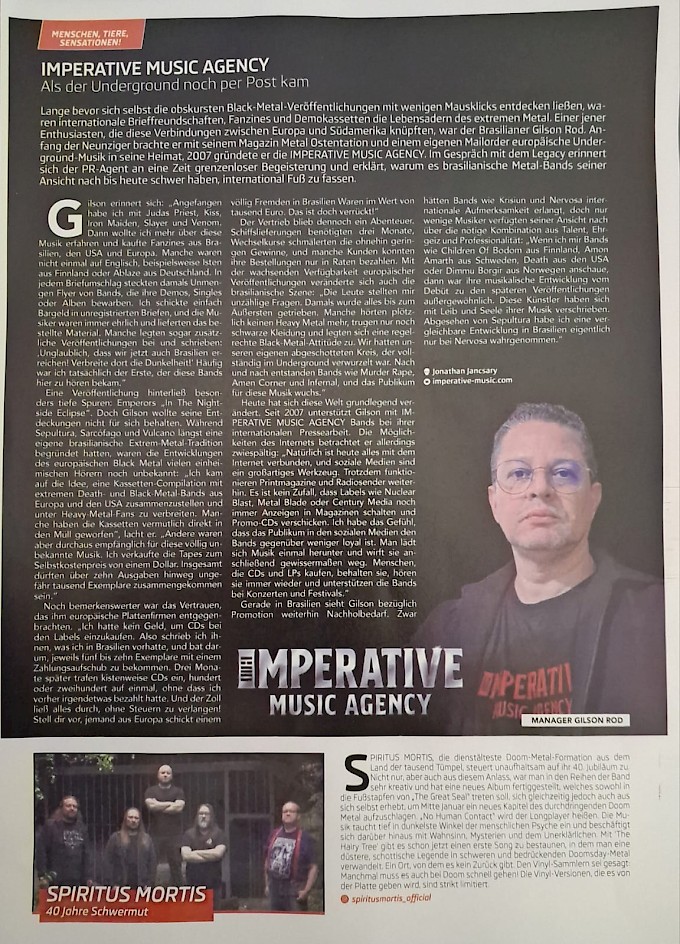
Hey Gilson, let's travel back to Brazil in the early 1990s, long before the internet made virtually every obscure Black Metal recording accessible within seconds. You were editing METAL OSTENTATION magazine and running a mail-order service, introducing Brazilian listeners to bands such as BURZUM, ROTTING CHRIST and BEHEMOTH. What originally drew you towards this emerging international underground, and how did you establish your first contacts with European musicians and record labels? Can you remember a particular release or encounter that made you realise you wanted to dedicate so much of your life to spreading this music?
Initially, I started out listening to Judas Priest, Kiss, Iron Maiden, Slayer, and Venom. I then began seeking more information about this type of music, purchasing fanzines from Brazil, the United States, and Europe—some not even in English, such as Isten (Finland), Ablaze (Germany), and Putrefaction (Sweden), alongside American publications like Sounds of Death, Metal Forces, and Metal Maniacs. This was my first step toward gaining access to underground thrash, death, and black metal bands. As was common practice, every envelope I received would contain a ton of flyers for new bands of that era, advertising their demo tapes like those from Necrophobic (Swe), Invocator (Denmark), Convulse (Finland), Behemoth (Poland) or 7" EPs: Dark Tranquillity, Monstrosity and LPs/CDs by Beherit, Emperor, Burzum, Entombed, Morbid Angel, Deicide, Gorgoroth, Mayhem. I would send cash inside the envelopes—unregistered—and the bands were always honest, sending me their material I’d ordered. Some would even include extra releases, with notes like, "Wow, I can't believe we’ve reached Brazil—spread the darkness over there!" In many instances, I was the very first person to hear these bands here. I still feel honored by that, as I have a deep respect for dark/underground art and those musicians!
A particular release was In the Nightside Eclipse by Emperor—that was definitive; you know, we’re talking about a Black Metal masterpiece.
You mentioned that you were among the first people distributing European Black Metal in Brazil, working with labels such as Misanthropy Records, No Fashion, Avantgarde Music, Pagan Records and Cold Meat Industry. What fascinates me is the enormous logistical effort this must have required: international correspondence, unreliable postal services, currency restrictions and even sending cash in envelopes to purchase records. Could you share one of your most memorable, perhaps even completely absurd, experiences from those days? Was there ever a shipment, business deal or personal encounter that seemed almost impossible at the time but ultimately became a great underground story?
As I read interviews with underground bands in fanzines, I became influenced by their ideas and actions. Since the vast majority of people in Brazil at the time only listened to heavy metal—or, at most, bands like Slayer, Exodus, and Venom—I had the creative idea to put together the first compilation on cassette tape, featuring extreme death metal and black metal bands from Europe and the U.S., to distribute among heavy metal fans. I suspect some people probably threw them in the trash (laughs), but others were receptive to this completely unknown material. It was sold at cost—$1 USD—and I lost count of the total, but I’d estimate around 1,000 units were distributed across the ten volumes I released.
What was an absurd yet incredible experience: I didn’t have the money to buy CDs from record labels, so I would send mails explaining what I wanted to do in Brazil—to kickstart the underground Death/Black Metal scene. I’d request 5–10 copies of each release, along with a grace period for payment. Three months later, boxes upon boxes of CDs (100, 200 at a time) started arriving, all without me having sent any money upfront. It was truly memorable—and, most interestingly, customs officials cleared the shipments without charging any taxes. I couldn’t even believe how well everything worked out. Imagine someone from Europe sending 1,000 euros' worth of goods to a stranger in Brazil—that’s just crazy! (Laughs).
After that, I started selling original material. Labels and bands would ship it by sea—it would take three months for the items to arrive in Brazil. Sending cash in an envelope was illegal in Brazil, and, of course, the exchange rate was extremely high; in the end, my profit was very small. Some customers didn’t have the full amount, so I’d let them pay in three installments—they’d pay me a little bit each month. It was all about spreading underground music; making money wasn’t the point, you see?
Brazil already had an extraordinarily influential extreme Metal tradition, with bands such as SARCOFAGO, SEPULTURA and VULCANO helping to shape the international underground. Yet you were simultaneously introducing a new generation of Brazilian listeners and musicians to European Black Metal and other extreme musical expressions. How did the local scene initially react to these unfamiliar sounds and aesthetics? Did you notice Brazilian bands gradually incorporating influences from the Scandinavian, Greek or Polish underground, and can you recall specific musicians or groups whose artistic direction changed after discovering recordings you had brought into the country?
Exactly; Sepultura and other bands had a major presence in the scene, but the audience had limited access to what was happening in Europe—such as Norwegian Black Metal. Beyond our own compilation tape, our mail-order service included detailed explanations to help people understand what this new musical style was all about. People would ask me many questions; back then, everything was taken to the extreme—many stopped listening to heavy metal or wearing heavy metal T-shirts, adopting a "black metal" attitude instead: looking menacing, wearing all-black clothing, and so on. We had our own closed-off circle, which was purely underground. Gradually, the first extreme Black/Death metal bands—Murder Rape, Amen Corner, and Infernal—began to emerge, and the audience for this genre started to grow.
One particularly interesting episode you mentioned was hosting Roger Reinhold of No Fashion Records and House of Kicks in Brazil to help distribute his label's releases. In retrospect, this seems like a remarkable example of how personal relationships connected underground scenes on opposite sides of the Atlantic. How did that collaboration come about, and what do you remember about Roger's visit? More generally, were there any particularly unusual friendships, encounters or cultural misunderstandings that arose from your dealings with European labels and musicians during the 1990s?
Well, that’s true—metal always brings people together, and we’ve developed relationships that go beyond just "business." Back then, in addition to his work with No Fashion Records and House of Kicks, Roger Reinhold—who is also a history teacher in Sweden—came to visit and document Indigenous tribes in the Amazon, as well as here in my own region (Mato Grosso do Sul). It was a great opportunity for us to exchange ideas and conduct business. There has never been any real distinction between me and the Europeans; in fact, even today, people often ask me whether I’m actually Brazilian or not. Roger Reinhold himself was impressed by my work, dedication, and effort within the metal scene, noting that I had an attitude similar to that of Satyr from Satyricon—in other words, I strive to be highly professional and truly useful to the metal scene.
You once compared your determination to promote extreme Metal with the missionary enthusiasm of Euronymous in Norway, although you never played in a band yourself. That's an interesting comparison because it highlights the often overlooked importance of the people who build the infrastructure around underground music: fanzine editors, distributors, promoters and dedicated collectors. Do you think these individuals received enough recognition for their contributions to Metal history? And looking back, how do you personally define the underground spirit that motivated you – particularly when considering that many once-obscure Black Metal bands have since become internationally successful acts?
I can’t imagine the German scene without Legacy magazine—even though there are major publications like Rock Hard, I think Legacy magazine is essential. The act of offering support and help should be sincere; many newcomers received their first real backing from sources like this. I suppose I did something similar myself: I sold demos and EPs—material that the big retail stores here in Brazil neither carried nor had any interest in stocking. I believe it made a difference, too, because a few years later, labels/licensors began licensing and releasing more death metal/black metal bands in Brazil. As I mentioned before, death metal and black metal started to expand, and more and more people were eager to buy. The "underground spirit" was intense—I’d spend all day listening to In The Woods, Rotting Christ,Dark Funeral; that underground material was my whole world. I still don’t know how it happened, but it was mind-blowing to receive a cassette tape from the UK—it was the debut album from Cradle of Filth. With Dani Filth’s vocals and that dark, somber atmosphere... back then, both bands and fans truly valued the smaller acts; underground material was given the recognition it deserved.
In 2007, you founded IMPERATIVE MUSIC AGENCY, turning your decades of underground experience into a professional service supporting and promoting Metal bands. In an article for The Moshville Times, you emphasised the importance of persistence, international networking, professionalism and maintaining an individual artistic identity.
How has your work changed since the days of photocopied flyers and handwritten letters? Has the internet genuinely made it easier for talented underground bands to establish themselves internationally, or has the overwhelming quantity of available music created an entirely different set of obstacles? And what exactly can a young band expect when working with IMPERATIVE MUSIC today?
Without a doubt, everything is connected to the internet these days, and social media has been a great tool; however, print magazines and radio stations still work. It is no coincidence that labels like Nuclear Blast Records, Metal Blade, Napalm, Century Media still advertise in print magazines and send out promo CDs. I feel that this new social media audience is less loyal to bands; they might download the music once and then just toss it aside. People who buy CDs and LPs keep them, listen to them repeatedly, and go to gigs and festivals to support the bands. Since social media audiences treat bands as disposable, they are disposable themselves.
Imperative Music Agency sends promotional material to high-quality media outlets (both print and online) to secure reviews and interviews—it is a medium- to long-term effort to earn your place in the music industry, you know. You see, Sepultura achieved good results with their third album; other bands had to release their first and second albums on a small label before moving to a major one. Therefore, the band needs to work on promotion and create better music to achieve better results.
Finally, after more than three decades of involvement in the Metal scene, you've witnessed enormous changes in how music is created, distributed, promoted and consumed. Yet you've always emphasised that your motivation was never personal recognition, but helping musicians find an audience. When you look at today's Brazilian underground, what excites you most, and what concerns you about its future? Are there particular bands or current projects you're especially proud to be supporting through IMPERATIVE MUSIC AGENCY? And if you could give one piece of advice to a young Metal enthusiast who dreams of contributing to the underground without necessarily becoming a musician, what would it be?
I believe many Legacy Magazine readers are familiar with names like Nervosa and Krisiun—in addition to Sepultura and Sarcófago. In my view, few Brazilian bands possess the intent, talent, and drive to grow and reach a higher level of professionalism. This is more common in countries like Finland—as seen with Children of Bodom—Sweden, with Amon Amarth, U.S. with Death or Norway, with Dimmu Borgir; their musical evolution from their debut album to subsequent releases was incredible, remarkable, out of ordinary. These artists dedicated themselves heart and soul. Aside from Sepultura, the only other instance where I’ve truly noticed this is with Nervosa
There is an advertisement from Imperative Music in this issue of Legacy; I highly recommend checking out these bands!
Try to look at the positive aspects of each band, and when addressing areas that need improvement, offer feedback in a way that won’t offend or discourage them. Some things simply take time to develop and master.
Thank you very much for your time, Gilson, and for sharing your experiences with our readers!
Many thanks to the entire team at Legacy Magazine. I’d also like to take this opportunity to thank the German metal scene for the pleasure of listening to bands like Kreator, Destruction, Sodom, Exumer, Morgoth, and Atrocity—as well as the various black/death metal bands from Germany—all of which hold a special place in my collection!
Gilson Rod
Imperative Music
Credit:
Jonathan Jancsary, Legacy.

